Thursday, August 23, 2018

The Iron Giant -- Fayette, MI


As I worked the Linhof during my first visit to Fayette, a man approached. About my own age, he'd enthusiasm to spare and an obvious desire to share.

"I saw you carrying that camera down the hill," he said. "It looked like your hair was on fire."


By way of explanation I waved one arm wide, as if that might take everything in and also excuse the metaphorically flaming hair. He seemed to understand. Two strangers by prior inclination tossed together on a strange land. Few words passed between us. Few were needed because there we stood.


Fayette Historic Park isn't curated architectural aggregate like Old World Wisconsin. It's no reconstruction of a legendary past as at Old Fort William, which though admirable is today neither where it once was nor old.


Unlike Fayette, Nonesuch comes shrouded in wildness that eats it. Though by no means impenetrable, Nonesuch is mostly incomprehensible and always will be. What stands at Fayette stands plain.


Victoria's character is down-home gritty. At Victoria on any given autumn afternoon, as long light fails behind the ridge and a lone docent fires up an aged smoker to chase the chill, with a shiver you might yet catch an authentic hint of a real past. Pumpkins and corn stalks optional.

In 1951 abandoned Fayette was cast in administrative amber. That's when the Escanaba Paper Company swapped it to the State of Michigan for publicly owned timberland.


Fayette Historic Park  was added to the National Register of Historic Places in 1970. The currently crumbling icon of Nahma is on that list too.


This is a ghost town shorn of ghosts. Under bright light it shines cold. Maybe because the only living thing that ever really mattered here was the fire, which is long gone. You wouldn't invite that back, even if you could.


Fayette first came online in 1867 along the eastern shore of Big Bay De Noc at Snail Shell Harbor, to take advantage of nearby Escanaba's then bustling commercial docks.


At Fayette the Jackson Iron Company built roaring charcoal kilns and blast furnaces fueled by local hardwood and limestone. The Company used those to transform their cut of the Iron Giant into more profitable pig iron.

A monument to this fiery enterprise remains, as at the burial site of a barbarian King.


Structures were built primarily of wood. Except the walls of the Company's last company store are lime mortar and brick.

Fayette's population likely peaked somewhere short of 500 people. Mostly, these were immigrant folk. Workers got paid monthly. In gold, they say. That's some Nice work if you can get it, as they say. Residential areas of the town were laid out strictly according to caste. In Fayette, you knew where you stood. There was a railroad.

A race track and baseball field were up the hill behind and above the furnaces. Woe be to you when you placed a bet on a horse or played a little ball while Fayette belched into a full fetch breeze off the lake. There was nowhere to go for the smoke and stench and flying bits of hellfire, save to follow you up and over the hill on your one day off.

Taverns and brothels were located beyond the playing fields. It's said the citizens of Fayette once torched a brothel as a penalty for sexual slavery.


The town boasted a theater. That's still on the second floor of the original wooden structure, accessible only via a single enclosed stairway. On a wall of the theater, preserved behind Plexiglas, you can read the signatures of traveling performers who once played there. It's a nice touch.

Yet each and every time I mount those narrow wooden stairs I recall Calumet's later Italian Hall disaster. What were any of these people thinking?


Did they just not believe they'd burn? How could that be? Especially at Fayette, considering why they were there. Bet no docent fires up that stage right smoker, these days.

In May of 1883 the furnaces were feared destroyed by the fire they were constructed to contain. How that can happen, I don't know. The Jackson Iron Company made repairs and in September production resumed. The charcoal iron market was by then in decline and market forces soon did to Fayette what fire couldn't, quite.

Midway through 1885, operations at the kilns and furnaces became intermittent. By 1891 they were done. Once set, industrial fire burned hot at Fayette, then was struck. The flame lasted twenty-four years.

The town changed hands. For a while, it was a resort. That too, failed.

These days, the trail down the peninsula toward Fayette Historic Park cuts through farm fields studded with towering wind turbines that look like massive inverted grasshoppers, broken legs spinning in the wind.

This enterprise is named The Heritage Garden Wind Farm. It's quite the undertaking. Likely, the garden's creators take actuarial certitude as in their long term favor. Over a broad stretch of land, they've claimed the horizon and much of the sky.


Critical elements of endeavor melded to time and place don't well translate. Not to words. Not to images. Not to administrative preserves. Nonetheless, at Fayette we've chosen perpetual maintenance, hoping the future will take a lesson and render better, more lasting product from history's raw makings than a postindustrial cemetery, where today rest the bones of an Iron Giant.


*


As of this writing, should you head north across that wild water you'll still soon enough spy the leaning sawdust burner of Nahma, near the mouth of the Sturgeon River with no sturgeon. The burner was built circa 1888-1893, after wooden Nahma burnt one time too many.

Enterprise at Nahma and Fayette didn't coincide but briefly. The former was being born with the latter on its deathbed. Under any circumstance, one couldn't readily see the other, for the white limestone cliffs protecting Snail Shell Harbor.

I like to think one summer night two lovers made their way up those cliffs above failing Fayette, to forget their troubles and focus only on the moment. Then the deep red glow of newborn Nahma burning caught their eye. There'd have been just enough overlap between the two enterprises for someone to have seen that, from high enough ground during a sufficiently dark night.

In any event, at the administered ghost town that is Fayette, no spark left by any flame once called upon to build a modern world exists. What remains there is abstract reflection.


Tuesday, July 17, 2018

And to dust...


Some years ago I learned of a sawdust burner still standing in the old mill town of Nahma, MI. On the Great Lakes that's rarer even than headframes, which once fairly littered both the Copper and the Iron ranges of Superior. These days what headframes remain are prized by preservationist's and woe be to you, should one fall down on your watch.

First visit to Nahma, I caught this on 4x5 chrome:


That happened when one year after Heather and I visited Fayette, we searched out this logging era relic. It's in the neighborhood of Fayette. I put the burner on the list, right next to the Thompson State Fish Hatchery.

When on the road never miss a fish hatchery. Just sayin', speaking of fish.

Anyway, apart from being a bit off the well beaten path, once you arrive in Nahma the sawdust burner's easy to find:


I don't believe the town's iconic leftover from glory days tilted quite so much that afternoon, when I crawled into it and Heather handed me the Linhof then stood watch outside, in case my being inside proved unwise. Probably, I entered here. About the only thing missing is the Abandon all Hope sign:


This spring when returning from Grand Marais and the Kingston Plains via Fayette, I traveled alone.

Nothing much is what it used to be and preservationists notwithstanding, life's dirty little secret is that it mostly never was. Certainly, Nahma's prized sawdust burner, having been built by the Bay de Noquet Lumber Company circa 1888 – 1893, operated until 1951 and left fallow after that is significantly degraded since last I visited.


Inevitably at some point the odds turn against you. As regards this burner, because I'd already been there done that and using large format chrome no less, I nurtured no particular ambition to venture inside. Outside, decrepitude now plainly reveals the structure's once sturdy construction of limestone and brick, sheathed in cast iron.


There's a plethora of what're alternately called Wigwam, Tepee or Beehive sawdust burners still standing out west, but evidence of only one other such artifact remaining anywhere else around the Great Lakes, where once we denuded old growth forests to build great cities to the south. That burner's at a splendidly abandoned sawmill in Balaclava Ontario near Lake Huron and it may or may not still be standing, as 2006 is akin to dog years when a thing's abandoned to northern winter's mercy.


It's likely little to none of the old growth White Pine purged from the Kingston Plains made its way down to Nahma, which fed primarily on local trees (why would that ever be a problem?) and mostly, at a different time.

Just the same, descending south from the Plains through Fayette and then to this once bustling sawmill town felt fitting. When it comes to old growth forests that's something of a trail of tears. For all the 2nd and 3rd growth woods along the way you wouldn't necessarily know that today, except scattered relics dot the landscape with remnants of failure hinting that once upon a time, something was definitely up:

Schoolcraft County, 2018


Note the American flags, bottom right corner of the image below, waving in the bright breeze of abandonment. What the hell does that mean?

These aren't an accident. They're not some coyote's trick. Are they like the little flags people fly on graves of soldiers to honor the fallen dead? Or is this what passes for defiance in these, our times? I'm not even sure I want to know...

Schoolcraft County, 2018


This year found the Kingston Plains awash in spectacular light. Some of the best of my career. More on that, later.

At least when the sun shines and fills Nahma's burner with fire from above instead of sparked by waste wood below, the light is always fine inside it. I'd bet with the fires doused nighttime's quite the thing in there and that local kids are intimately acquainted with it. Full sun's all I can speak of, firsthand.

On a shining spring afternoon, I took what might be my last best chance to poke the Nikon, if not quite my head, inside.

As much as anything the place resembles the construction of a near forgotten people. Perhaps they were surrounded by desert. Which of course this tower once more or less was, when all the timber was gone and the last sawdust burnt.


"Nahma" is derived from the Anishinabe word for sturgeon. Long ago, native people gathered at the mouth of the Sturgeon River on Big Bay De Noc and took sustenance from a prehistoric line of great beasts come in from the freshwater sea. Those fish inevitably returned each year to their natal stream. Folk could live on that, provided they also lived with it.
In time, the lumbermen arrived and the native people who knew the fish dispersed. If not by then soon after, the mighty sturgeon were gone as well. 'Wild' only takes so much human industry before it flees or fails.

For a while, this community named after a vanished fish prospered. Once the lumber ran out, the timber bosses took their hint from the sturgeon and the flowing wealth that created an illusion of prosperity was permanently stanched.

Far as I can tell, today no sturgeon returns each year to the river named after it. Yet the ancient beasts still swim big water nearby and the greatness of these fish is again recognized by men. That means there's hope yet, for the sturgeon.

Maybe not so much for the iconic sawdust burner at Nahma, the region's last of its kind. As of now it survives tilted on a grassy spit of land that reaches out into the bay, near where sturgeon and native peoples once thrived.


I for one hope the burner stands sentinel to failed history until the day the sturgeon return. Then let the thing go to dust.

That too, seems only fitting.

Thursday, June 14, 2018

Speaking of Fish...


Grown dissatisfied with the state of things on my native prairie and itching to do real work, I chased spring north. At the eastern edge of Pictured Rocks National Lakeshore spring even now edges into summer, which comes late to the Northwoods and most years, doesn't stay long. I arrived just in time.

This was strictly a hit and run working trip intended to fulfill a longstanding promise I'd made to myself. No time to recreate. I worked hard and nailed it. Will show & tell more, later.

Tiger Swallowtails were courting, en masse. More than I'd ever seen in one place. Biting flies and mosquitoes swarmed. Fresh life was thrown everywhere, in abundance.


Upon hearing rumors of trout working their way up the Hurricane River and even though I wasn't carrying my fishing gear, of course I went to see for myself. Never pass up a chance to watch fish do their fishy thing, I say.

Behold, a true wonder of nature:


It's inestimably rare, to catch a fish with only my camera.

Intent on spawning, these trout are working their way up their natal stream as far as they can go, which on the aptly named Hurricane is likely a set of falls not far upstream from this. They push forward relentlessly and having labored mightily to get only this far, are desperate to not fall back.

Notice how the biggest fish in this trio taking a breather is nestled in behind the smaller fish, making his task easier:


As this fish gasped for breath in the short rushing river, its upper jaw threw a spray of current a full foot or more into the air. I've never seen the like.


Predawn along the Adams Trail Saturday morning last, wolves sang in the fast fading dark while myriad birds and frogs offered up voices in song.


Later, coyotes yipped and yapped. With full sun, Trumpeter Swans and Sandhill Cranes called.

And for a little while of transcendent time on a Monday morning at the cusp of summer beside a wild Northwoods river, fish were the definitely the thing. Far as I know, those don't sing. Or if they do, it's in voices we don't hear.

At any rate, one can't always have everything, but sometimes in the Northwoods magic happens and like a gift you get what you need. Even when you didn't know you needed exactly that.


Wednesday, May 23, 2018

Spring, 2018, Part 2

Well then.

Persistently colder than normal. For instance, last Sunday on the prairie it got all the way up to about 48 degrees and it poured cold rain.

Heather calls that "camping weather". Once, we were young. At least she remembers.

Did I mention the rain?

To date, the 4th rainiest May on record, with more May (and rain) yet to come.

On those few scattered nice days I've been out, Spring 2018 is thoroughly confused.

By this point, I'm not. So rather than tap dance around in my back catalog any further, I've...


See you sometime in June...

Thursday, April 19, 2018

Spring 2018 or… Not. So. Fast.


This year, what folk like to say always happens but only occasionally does actually might. This year, the prairie will likely turn from winter to summer in a thrice. No gentle, glorious unfoldment of spring need apply.


Sure, at some point delicate flowers will bloom in detritus and blackbirds will call. That time's not yet. At this rate, humidity and biting insects might follow fast on the tender season's heels. There'll be scant chance to see the swamp through the trees before an abundance of everything obscures the view.


Of course, frogs will sing. Probably they already have, on one or more of a few sunny days when it wasn't also too near freezing. Like people, frogs jump the gun. In any event, I've not been there to hear. On the prairie this week last year, cacophonous frog song called me to the dance.


This week last year, swamp willows led the way for barely blushing oak savannas. Geese tended goslings.


In the swamp, Sandhill Cranes stalked while marigolds glistened.


At swollen water's edge, the wetlands popped.


Hillocks became alive.


The sun shone and a cold land warmed. As it should, on the prairie in April. Blackbirds called.


This week, on Sunday and Monday then again yesterday, it snowed. To date, April 2018 makes for a decent February pretty much any year. The only thing really happy in the garden is the lupine. That figures, as its seed came direct from the Northwoods.

As to those Northwoods, whose green face I savor best at first blush in spring, before this week word to fishermen awaiting the May opener was to not pack away the ice fishing gear. A couple varying feet of winter's ice still lay protected beneath a couple varying feet of accumulated snow and it'd be awhile, yet.

Then came the April blizzard of 2018. It'll be a while longer before ice fishing is over, I'd think.

A dear friend sent this dispatch from the front. It captures Superior at the Minnesota shore near Split Rock. I looked at the image hard and long for any sign of spring and found none.


                             ©PKucera

Better him than me I think, working the blizzard and no thought whatsoever of spring.

They say next week should be about "normal", I'll believe that when it happens. Today the prairie remains largely brown, sodden and chill, but at least I've a happy lupine for company.

Thursday, March 15, 2018

Old World Craft


Unlike the relocated, reconstructed buildings at Old World Wisconsin, Ontario's Fort William was from the ground up recreated into the Canadian National Historic Site that it is. Not exactly on the Kaministiquia River where it used to be, either. Small wonder. I've seen the waterfront on Superior at Thunder Bay.


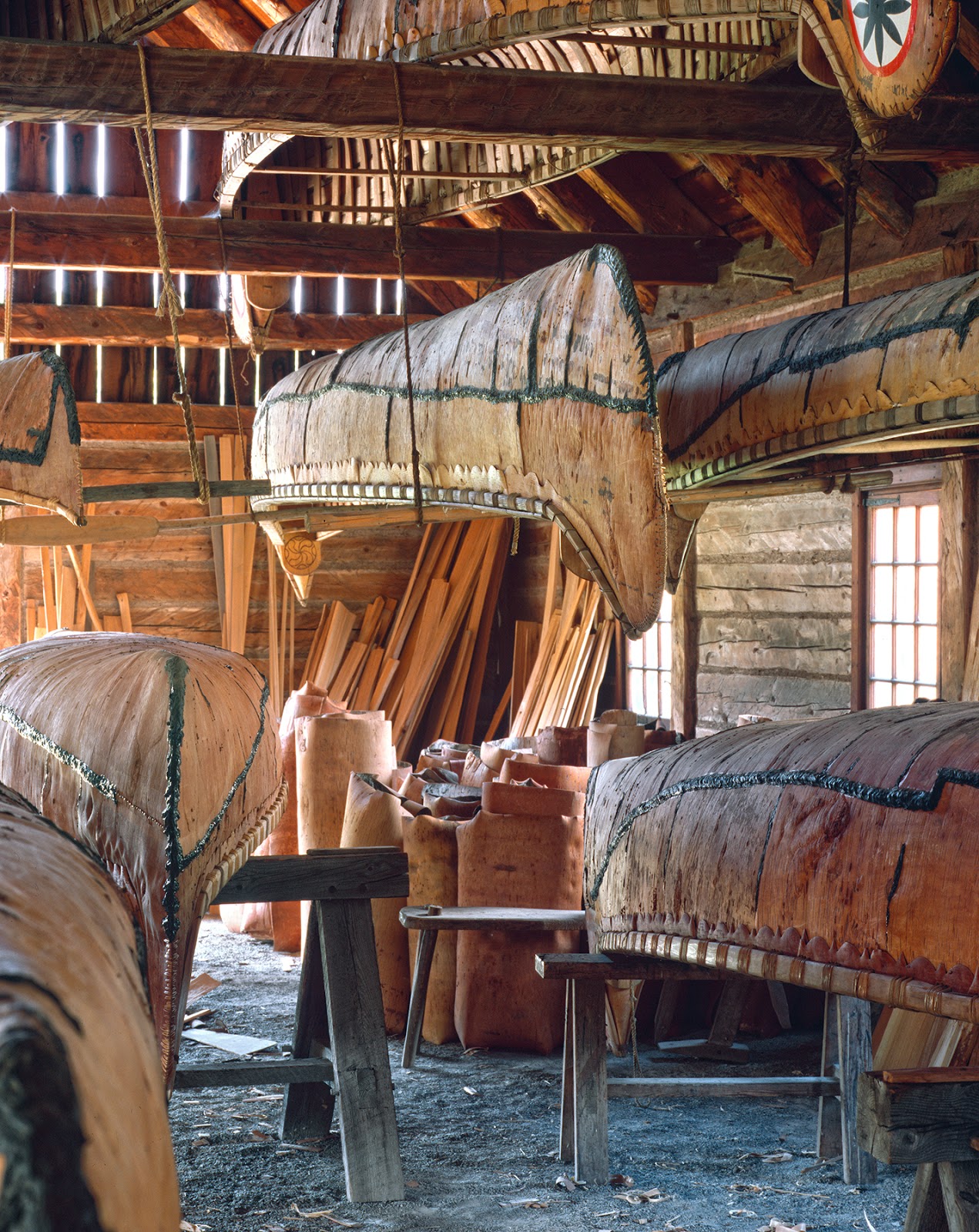
They handcraft genuine voyageur canoes inside that modest structure captured above. On reasonably sunny days, the place is bathed in about the richest interior light I've ever seen. During my first visit to Fort William some decades ago, I could hardly believe my eyes:


I love canoes in much the same way I love great light.

Specifically, I love my canoe, a Nova Craft 'Bob Special' purchased at the retail shop of the late legend, Ralph Frese. A blacksmith, environmentalist and raconteur (among other things), Ralph was probably best known as a maker of voyageur canoes.


A complex kinda guy, trust me. By the time I met him, Ralph's international reputation well established.

For much of my life I rented canoes as needed, mostly from Bob Zelinski's Sylvania Outfitters. Heather & I ride one of Bob's old 18' Grumman aluminum beasts near to hell in The Bear Story.

Used to be, just over from the Outfitter's stood the Watersmeet version of Stark's Cabins. Those came down before I ever got to shoot them. There's also a colorful vignette about the sunny morning when waiting on Bob I met two aged backwoods Bingo ladies in half light. That tale should probably be told, but I've digressed...

It was a long time before finally buying my own canoe and I picked the best place I knew to do it. On the big day, Ralph Frese worked in his blacksmith shop out back. As a salesman completed the paperwork, I dared wander over and introduce myself to Ralph.

"I've wanted a canoe for thirty years and today is the day", I said.

Ralph looked me up and down. He snuffed.

"Wasted thirty good years then, didn't 'ya."

Sometime later Ralph Frese and I discussed making a documentary about the Fox River in Illinois. That didn't go far. In my experience, Ralph suffered no fools.


The canoe makers at Fort William still practice old world craft in a time-honored way. That they do it in a splendid working environment must be a bonus.


During my latest visit to the workshop at Fort William, a craft master rather obliquely shared with me his opinion of Ralph Frese. Turns out not everyone in the voyageur world holds an unvarnished opinion of Ralph, ce' la vie.

I appreciated the man's honesty and additional insight into a legend I was privileged to know somewhat, almost as much as I appreciate both men's craft.


Winter's ending. Not so much in the Northwoods, but still. Long light grows shorter by the day. The inevitable turning is here.

This year on the prairie that means that though ice is out it's too stinking cold to indulge the canoe. Perhaps soon I'll suddenly find I'm too old for mine. That season's sure to come. When it does there'll be nothing sudden about it, truth be told. We'll see.

Meanwhile, on a chilly sunny Thursday just a few days short of the vernal equinox promising better days, here's to old world craft and old canoes. To cranky old craftsmen, anxious old fishermen and luminous light.

Always, the luminous light. No surprise to me I found that in abundance, in an old world canoe shop.


Also, to the memory of notable voyageur Ralph Frese and his once famous blacksmith/canoe shop. There, a multi-story apartment project is now being completed. You can rent a place on a bustling commercial street at twice monthly what years ago I once paid in full, for my very own canoe.

Ralph was right.

I've done my best to make amends since, because life sans my canoe would've proved too short...


Thursday, February 15, 2018

Calling All Artists, 2018


Thought I'd lead with spring because I sure could use some. The shank of winter runs long on the prairie and it seems every day brings more dire news.

At least we know there's a cherry red Tesla ridden by a mannequin wearing a spaceman's outfit hurtling through space in our collective name while listening to David Bowie. And if you don't believe me...


So we can do that, but not keep our children safe in schools we send them to. Go figure.

I've written a great deal about my artistic residency in the Porcupine Mountains, courtesy of the Friends of the Porkies. Time's come to do that again, as your application for the Artists in Residence Program is due no later than March 30th, 2018.


I thought this year I'd show more than tell. Suits my mood. Maybe it will yours, too.

These images were all captured within the boundaries of the Park. The image immediately below was taken just a short walk from Dan's Cabin. To and fro, you'll pass it every day.

Tell me you don't want to be right there right then, right now…


The world needs creatives. We're obligated to help them thrive. The Friends of the Porkies' artist in residence program does exactly that. It's hosted a dizzying variety of artists across a wide array of creative disciplines.


I've included images here from three seasons in the Porkies. I've had enough of winter. Maybe you have too.

Take this little tour of the Porkies. Then take the chance and submit your best work to the Friends.


Go for it.