Friday, February 14, 2014

The Porcupine Mountains, Part 2

To me, one of the most stunning developments in American politics over the last 40 years or so is the indiscriminate hatred of government that drives so much of our freshly populist political rhetoric.

That used to be merely the province of hippies, malcontents and other outsiders. Regular folk and mainstream opinion countered that desultory view with determination born of an innately positive attitude and approach that had been passed down to them across generations.

Today, demagogues that relentlessly peddle this new delivered wisdom want us to buy into the silly notion that an outright rejection of our Government is a core value of the American character.

Self-destructive stuff and nonsense, is what that is. Long ago, Mr. Lincoln said: "A house divided against itself cannot stand" and he was right. He's still right.

Mind you, I'm not saying folk should just blindly trust their government, American or otherwise. Far from it. Anyone who came of age after the 1950's knows damned well that's unwise. But American government belongs to all of us, just the same. And we must each take full responsibility for it, as the ongoing American Experiment in liberty requires collaboration among free citizens or it fails.

It's hard to counter delivered wisdom, especially when pandering to people's fears and despair is so effective.

But if you're tired of all the gloom & doom relentlessly tossed your way and would like a short shot of real evidence that when people of good will partner with their government things still work the way they're supposed to, or if you've come to believe such things are no longer possible, you need look no farther than the Porcupine Mountains for proof positive that the shrieking fear mongers who so beset the public conversation these days are feeding you a steaming pile of of hooey.

Because there, in a region ravaged by hard times, Americans continue to make things better for all of us by partnering with their government and working together for common cause...


A People and Their Government at Work (Revised)

In the arena of contemporary public discourse, American government and government workers are routinely disrespected. How and why that happened doesn't much concern us here.

What's true is that a constituency exists for each taxpayer's penny spent, for everything the government spends those on. From warheads and surveillance to corporate welfare. From education and environmental remediation and public health, to the critical research necessary when trying to transition an entire civilization over to sustainable against a fast ticking resource clock.

Our inability to make government function wisely and at optimal efficiency leads us to a conversation where government itself seems rendered unsustainable. Save that almost everyone who yells "Cut!" is yelling about cutting yours not theirs.

So there'll always be some form of government left to deliver theirs, if not yours.

When fueled by the populist righteousness the democratization of all media has unleashed in us, the nuance of real life is too often obscured and our public conversation fails.

Porcupine Mountains Wilderness State Park is a landscape eminently suited to the restoration of healthy human perspective.


It's prudent to remember that your liberty to visit was first secured through direct government response to local citizen advocacy, while today an ongoing and robust public/private partnership smooths your way.

Without government & government workers, it'd be just you alone against nearly a hundred square miles of undifferentiated, cut over northern stump field turned to slowly evolving desert, like out in the Kingston Plains. It's unlikely you'd ever think to go there or even guess this exists, much less be able to launch a boat on it or snap a picture when someone does:


The real world stays open 24/7, so folk wander the Porkies day and night through the seasons. It's impossible to tell exactly how many people visit the place during any given year. Something upwards of 300,000, best guess.

And they come from all over the world.

There're day trippers, trekkers, skiers and kayakers. Families with picnic baskets next to beach blankets. Fishermen and other dreamers. Hunters, bird watchers and gatherers of berries. Collectors of solitude, busloads of school kids, devoted travelers and casual tourists alike.

And during a few short weeks in autumn, the Porkies play host to flocks of migrating photographers who descend on the landscape like hundreds of busily clicking starlings, only to flee south again when leaves fall to a wet north wind.

So the Park employs 35 workers to provide for the education, amusement, comfort and safety of all comers.

That's 12 full time paid staff and 23 part time paid staff to ride herd on better than 300,000 of us let loose over 60,000 acres of otherwise inaccessible wildness, open to us 24 hours a day, 360 days a year.

These 35 government workers maintain 87 miles of mostly backcountry trail. They clean toilets, cut grass, respond courteously to every inquiry and rescue the careless. They fix what we break, replace what can't be fixed as budget allows and otherwise faithfully serve the needs of everyone who visits.

They do all this and oversee the natural health of the place too.

Being so near the Visitor Center during my stay at Dan's Cabin offered the opportunity to interact with Park staff far more than is usual for me, as my home turf of the Presque Isle is something of a lonely outpost by comparison. Near the end of my residency, I took advantage of one of the fine interpretive programs regularly offered by the Park.

Which is how I came to spend a bit of quality time with Lynette Score, government worker...


When traveling the Northwoods, many people hope to see a bear. The Porkies are a good place for that, as bears roam throughout the Park. But most times, bears know you're there before you do and head the other way. Typically, any easy way to turn the odds of a sighting in your favor invariably courts disaster for both you and them.

Near the end a damp, chill afternoon, Lynette greeted me and two other travelers at a trailhead, then led us into the woods to get up close and personal with the next best thing:


That's a split trunk Birch and one-time winter home to a bear. It's located not far from the road, but you'd never know it's there and in all my years bustering 'round the woods, I'd not stumbled across the like or I might've tried sleeping there myself during some mystic summer night of my youth.

In command of her subject and thoroughly engaging, Lynnette said this was likely the den of a mother bear, as those need to approach winter's rest with far greater care than do their male counterparts. After all, it's the female bear that carries the considerable burden of ursine reproduction, a truly extraordinary process that Lynette explained in terms easily understood.

On the other hand, guys being guys whatever the species, male bears sleep pretty much wherever. They might fall asleep up in the branches of a tree or just lay down atop a depression in the earth  and nod off, only later to be covered by a blanket of snow.

Take this little guy, who made his den smack dab in the middle of what in full winter becomes a groomed, cross-country ski trail and for a while at least, slept right through all the traffic that passed over him. With the discovery of the den, Park staff ceased grooming and rerouted the ski trail, though a trail cam later captured the bear's early emergence on a too warm day in March -- mighty wet but apparently none the worse for wear.


Image courtesy of the Michigan Department of Natural Resources


And while I know a bit about bears, it was Lynette who clued me in to the disagreement over whether or not they're true hibernators, because bears confound our necessarily reductive scientific criteria for that by occasionally waking up.

Like when some hapless intern is sent into a den and checks the hibernation temperature of a bear via insertion of an anal thermometer...

Lynette offered the opinion that whether bears aren't true hibernators or are the most adept practitioners of it, the bear shows us that the wonder of Nature resists efforts at reduction.

Of course, she was right.

During these hard times and especially considering her expertise, young Lynette Score might well have accepted full time employment downstate. Instead she chose to take her chances and work part time in the Porkies, hoping to make a home and build a career serving people and a landscape better suited to bears than to most humans.

Would that more of us had that kind of moxie or shared that level of commitment.

And from now on, whenever some cackling demagogue appropriates government workers as excuse to constrain a people's government down to the narrowest of selfish purpose, Lynette and her co-workers who've chosen tough careers in public service at publicly funded Porcupine Mountains Wilderness State Park will be among the folk I think of first.

*

Significantly, the Porkies benefits greatly from a working public/private partnership through which citizens and their government together put shoulders to the load and achieve common goals.

Having worked my way right through my residency, I was well & truly done and it was only on the last full day when finally I took all things easy.

Late that morning I stopped by the Folk School for a bit of business, but mostly for the warmth of friendly company. There I chatted while everyone else in the room busily made for themselves pretty much from scratch a traditional Finnish stringed instrument, called the kantele.


Later, they'd learn to play it.

Friends of the Porkies thrives on a deep loam of citizen advocacy and appropriate government response. As the Artist's Residency is one result of that, I came to know this fine organization far better than I previously had.

It's like a big old backwoods Hemlock. The landscape might be hard but the Hemlock rises tall and sturdy just the same, with roots spread wide and the whole of the thing essential to the forest's continuing health, as new life invariably springs from old.


First there's the famous Porcupine Mountains Folk School from which the artist's program, Dan's Cabin and a host of other good things stem.

Like the annual Porcupine Mountains Music Festival that attracts both talent and audience from far and wide.

Then, should you care to see what a top drawer workshop overseen by a diverse cooperative of dedicated creatives looks like, go here.

Across all the miles we've traveled together on this Odyssey, I've kept a special watch for sustainable practices because it's only through those that the region will ever escape the historically destructive cycle of boom & bust.

Turns out, the Superior region is a veritable Petri dish of those.

Prime among them is the personal partnership forged over time between concerned private citizens and their government, to advocate for ancient Kag wadjiw. That's a distinctly American relationship that assures a unique landscape and the people who live on it not merely survive but thrive, so that all of us are the better for it.

I'm the better for that partnership.


And if you're a working creative, please drop by next week to learn how you might be too...

Friday, February 7, 2014

The Porcupine Mountains Wilderness, Part 1

Following my stay at Dan's Cabin courtesy of the Artist in Residence Program run by the Friends of the Porkies, it became my business to do everything I can whenever I can to promote the interests of the place and of its most devoted Friends.

It's an ancient landscape that encourages profoundly personal connections that last a lifetime. My love for the place trails all the way back to the quick dimming years of my largely misspent youth. My adventures there gave me something precious to hold on to year after year and you'd think things couldn't get much more connected than that.

But during the penultimate trip of the fieldwork and due in no small part to the people who serve this magnificent land, I found much, much more. Through those couple of weeks spent as a guest in splendid isolation, the land and its people enriched me in ways I could never have anticipated.

With a new year's Artist in Residence Program submissions deadline approaching, the steep hills still shrouded in snow, Superior blanketed with an expanse of ice greater than she's seen in years and no end soon in sight, the time is ripe to dig back in to one of the most splendid places on the Superior Basin.

And to honor those good, hardy folk who devote their lives to its continued wellbeing. Because through their labors they honor the real world that sustains us.

So if you've never been to Superior's Porcupine Mountains, this is the year you should go. If you're an old lover of the place, start dreaming now of spring and making plans. And if you're an artist in need of solace and support, awash in an undifferentiated landscape of noise, read on over the next month or so while I fill you in on what riches to look forward to, gleaned during a visit to one of the region's authentic and lasting treasures...


The Porkies (Revised)

Though coincidentally home to porcupines, when viewed from the east this range of ancient mountains resembles a crouched Kag, or Porcupine. That's why they were first called Kag wadjiw by the Ojibwa.

The name stuck.

Due to years of citizen advocacy, this magnificent place was first secured as a park in 1945. With further protections since gained, the Porcupine Mountains Wilderness became the crown jewel of the Michigan State Parks system and today ranks among the finest relatively undisturbed landscapes on the Superior Basin. At its heart stands nearly 35,000 acres of virgin northern hardwood forest, said to be the largest such tract to remain in North America.


After near to twelve hours on the road and well past dark, on the first night of our first trip together to Superior, Heather and I arrived at the Presque Isle campground that marks the western end of the Porkies. We set up camp and devoured a stack of hastily prepared Bisquick pancakes slathered with rich currant jelly made by Heather's dad. Then we fell asleep to the whisper a big lake offers at its shore.

The next morning brought our first Northwoods lesson: leave a plastic jug of dough on the picnic table overnight and you'll then have to clean up after a critter savages the jug for to get at the bounty of tasty goo.

That morning also revealed that we'd pitched our tent at the forested edge of a high bluff looking roughly west over Superior, so it was all good.


Our relationship with the place now stretches near to 40 years and is indelibly personal.

In the Porkies Johnny, Heather and I bushwhacked over the hills searching for evidence of Copper Complex people, to no avail. Likewise our always half-hearted hunt for the crashed B-17, artifacts of which can be found in collections scattered throughout the region.

We didn't actually look for the legendary pictographs as told to Henry Schoolcraft by the Ojibwa shaman Chingwauk, but always hoped we'd somehow find them anyway. To date, no one has...


It was on the South Boundary Road at dusk where we encountered our first wild wolf, many years before those were properly reestablished and long before one could even imagine we'd be reengaged in killing them for sport, as we are again today.

This particular wolf worried over road kill just off the shoulder of the road.

We slowed and pulled alongside.

The wolf lifted its formidable head to address us with the most sentient eyes I've ever seen. In them was no sign of fear or aggression, though they fairly shone with awareness and make no mistake.

In response, Heather rolled up her window.

After a while the beast took a step back and drew itself in to the darkening wood. We left the wolf to its business and returned to camp exhilarated.

I've not again been so close to a wild wolf until autumn of 2012, during this Odyssey. To be sure it was under entirely different and unhappy circumstance, but again at the side of a road.

Heather and I spent half our honeymoon at the Presque Isle. On my 2nd night of marriage I managed to bounce a thankfully dull axe off the back of my hand. Heather fixed me then and the template for our continued wedded bliss was set.

Of all the fish I've ever tussled with, by far the finest of 'em swam the Presque Isle.


I once fought a fish upriver and down for more than forty minutes, tethered to only 6# test. Finally I gained the upper hand. At last I brought the behemoth to dark water at river's edge. In another moment, I'd need come to grips with a monster from the deep.

Then with a sharp thwipt no doubt heard all the way to Isle Royale, the line snapped. My knees shook while I used my left hand to pry loose my right from the rod. The name of the beast remains a mystery, but it's Promethean nature has never been in doubt.

Then there was the time the biggest Steelhead I've ever seen rose from beneath my feet as I retrieved a spinner through fast water while standing on an undercut shelf. I swear she never moved a muscle of her brightly colored flanks and was simply one with the current so that when the spinner reached just there she was there too, to kiss it softly as it passed. And the fight was on.

For... I dunno, maybe three seconds. Seemed like forever then as now, so amazing the sight and rich my memory of it.

Funny, how often fisher folk's greatest tales involve no fish at all or the one that got away. Best leave that to ponder for people who don't fish...

And did I mention that the South Boundary Road is my favorite drive anywhere? Miles of classic two lane blacktop rolling up and down and all throughout the naturally indistinct boundary between governmentally sanctioned wilderness and not.

The Porcupine Mountains Wilderness is wonderland. A complex, richly rare landscape ideally suited to adventure and quiet contemplation in turn and at your discretion.


It's for that and because I take the place so personally, that we'll spend some bit of time there over the next few weeks...

Wednesday, January 29, 2014

King Copper -- Nonesuch (Revisited & Revised)

Throughout this Odyssey, I've referred to the always shifting promise of future prosperity offered by resource extractors in exchange for us letting them take the last of the region's minerals today as a lie.

That's not politics, that's the truth.

Better than 170 year's worth of evidence in support of this hard truth litters Superior's basin, perhaps no place in the region more vividly and readily accessible than on the Keweenaw Copper Range and the Gogebic Iron Range.

At some point and no matter how desperate the times, we must stop buying into the lie. Now that what's left of the copper and the iron is down to the last of it and if we buy in one more time there'll never again be a choice to be made, the time to stand fast against the siren song of profit is now.

Since we'll spend February revisiting the Porkies, it's appropriate that I offer up Nonesuch as Exhibit A of how some of the hardest working folk there ever were found themselves way down the pecking order when it came to resource extraction and the wealth outsiders glean from the landscape through the sweat and pain and labor and hopes of people who then prove every bit as disposable as is iron or copper.

And who in the long run matter less than either, when it comes to profits.

Don't believe me? Fine. There's no good reason to take my word for anything and with dozens of sites scattered across the region, you can go see for yourself.

So next time you're near the Porcupine Mountains Wilderness, take a worthy side trip.

Because these days the Park conducts regularly scheduled tours of Nonesuch, a bustling town of 300 or so hardworking souls and their families that once shook the ancient hills and blackened the sky with the sights, sounds & smells of a promised, lasting prosperity.

And which today is no more...


Image courtesy of the Michigan Department of Natural Resources


The special relationship between copper and people across the Superior region dates back at least 7,000 years because geology made it easy.

Ordinarily underground, around the lake and significantly along the Keweenaw Fault, this easily worked metal was found on or just under the ground; casually discovered, easily accessed and put to handy use. Many of our most famous historic mines were first dug on prehistoric pits and those were first dug with tools of stone often lashed with hide to wood.

By the middle 1800’s, much of the Upper Peninsula was being stripped of its great forests. By the turn of the century, what was left by the lumbermen fell to the axe of folk that moved in after. Notable were miners, who needed wood not only to fuel the fires of industry but to warm hearth & home.

Before long the landscape that once and again nurtures wilderness resembled post-nuclear catastrophe. But at the time, it looked only like progress.

During the great copper era of the 19th Century, dozens of working mines dotted the region and if you add the wildcatters and unnamed speculations, the number climbs exponentially from there. Despite the tens of millions of 1880’s dollars invested and the mountains of material hauled from the ground through the heroic toil of thousands of mostly immigrant miners, only a rare handful of operations ever sustained any profit at all.

That brings us to Nonesuch.


Located at the southeast corner of the Porcupine Mountains Wilderness State Park, Nonesuch operated in fits and starts under five different owners roughly from 1867 to 1912. Its prime years were 1879-1881, when the mine is said to have returned a profit, however marginal.

The town built to support the mine peaked at perhaps 300 souls. Though little is known of cultural life specific to Nonesuch, there was a school, a boarding house, stores, a stagecoach stop and other trappings of small town community. Still, life for the workers and their families was hard and not just by modern standards. Nonesuch lost its post office in 1887, when the machinery at the mine was disassembled and shipped away to other, more likely ventures.

While some folk stayed on and though the Calumet & Hecla Mining Company later dropped some 200 tons of equipment at Nonesuch to try again, it was all downhill from there.


The town of Nonesuch as it appears today


When I first went in to Nonesuch, the site was privately owned and thoroughly abandoned. A friend said: “Watch for the sharp turn in the South Boundary Road. There’s short gravel to park on, behind the trees. Walk the old road and when the trail hangs a left, turn right and go down the hill. Keep your eyes open.”

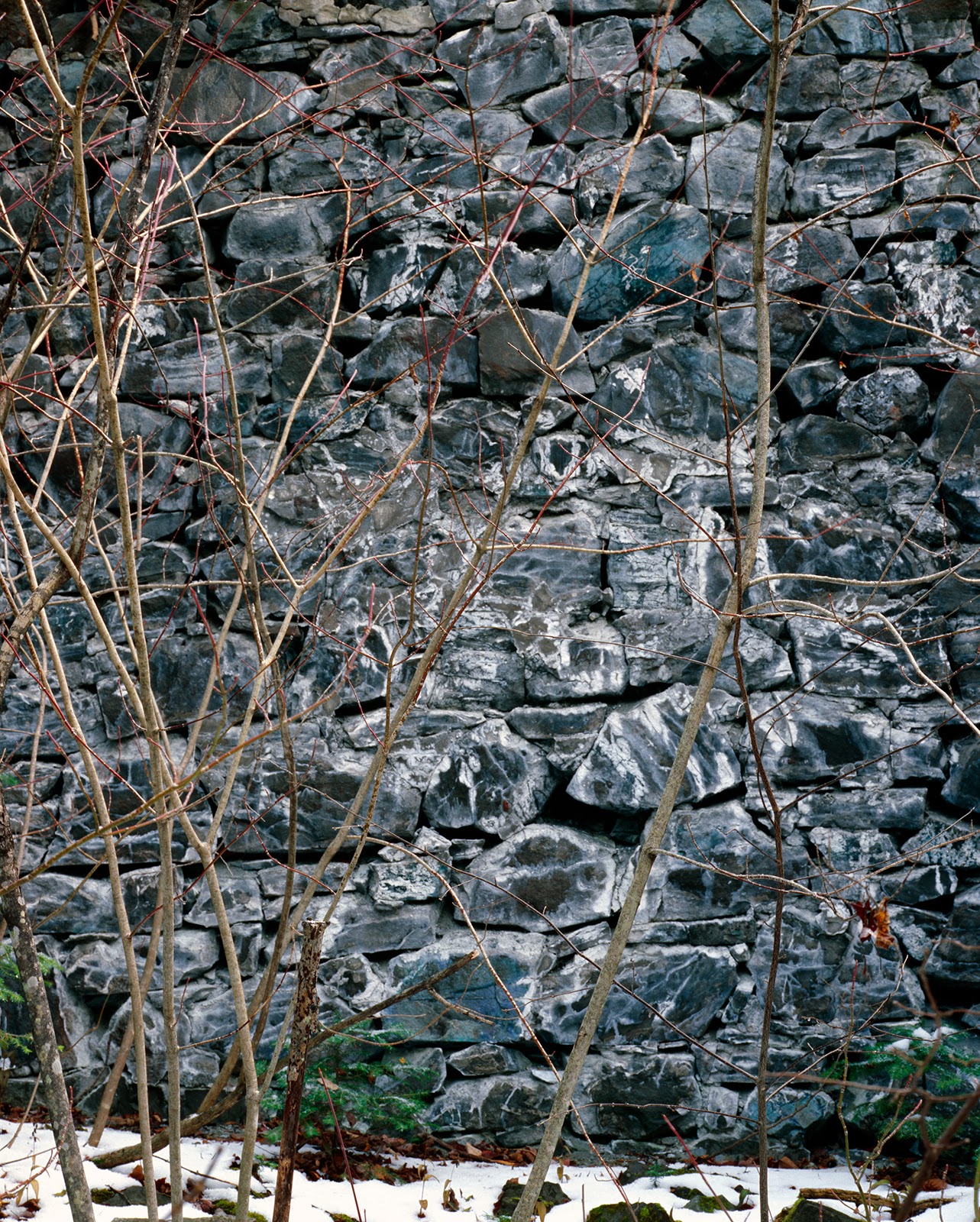
Our eyes were soon wide open because what litters that steep hill blanketed with dense forest are sights like this:


Huge dark stones mortared into thick, towering walls rise through obscurity in a wilderness that’s worked for more than 100 years to reclaim those stones for its own.


It’s hard to overstate the case for how special this place is. Walking the trail down that hill to catch first sight of the ruins of the Nonesuch mine is akin to an explorer being caught unawares by remnants of a great race of builders, with only mysterious works of stone as evidence of their existence.


The problem at Nonesuch was that unlike most of the rest of the Keweenaw where copper was found in thick veins or even in boulders on the surface, here the commodity is particularly fine and all but inseparable from within a bed of sandstone and underlying shale. The customary method of separating copper from poor rock in a stamp mill didn't work with Nonesuch copper.

But where there’s a resource to be tapped, human ingenuity is brought to bear.

During the 1880’s, the Nonesuch Syndicate engaged in a radical process to recover copper by dissolving host rock in harsh chemicals, to cull metal from waste. Though the process later went on to great success, this first attempt failed.


Evidence remains of the chemical leaching process tried at Nonesuch


In the ‘Copper Handbook of 1902', Horace Stevens wrote of Nonesuch:

“Discovered in 1865, the mine was first opened in 1867, since which time it has swallowed several large fortunes, and has yielded the insignificant amount of 180 tons 1,072 pounds of refined copper from one of the richest beds of copper-bearing rock ever opened.

“The copper is there -- millions and millions of pounds of it, not worth a penny a ton in the mine. Someday the problem will be solved and a new crop of millionaires made from Nonesuch.”

And that, as they say, was that. I suppose those millions and millions of pounds of copper are still there. For certain, no new crop of millionaires has been made from it.

Today Nonesuch is protected by the Michigan DNR and the Keweenaw National Historic Park, which combined efforts help protect the last vestiges of regional cultural heritage before those are swallowed by time made harsher through abandonment and neglect.

There’s never been a complete archeological survey taken at Nonesuch. Consider please, that the removal of artifacts at this or any historical site is the destruction of knowledge.  Not merely a crime by law, it’s a crime against our living cultural heritage.


So when you visit Nonesuch, be content to stand in awe of what the industry of our forebears left in their stead and of how the wilderness reclaims it now, right before your eyes. Sit quietly beside those sentinel walls amidst towering trees. Try to imagine what the place was like at its height -- the stench of caustic chemicals in the air, the sounds of axmen making constant fuel from dwindling timber, the persistent pounding of a stamp mill shaking the hill upon which it’s still perched and everywhere the sweat of labor and lives spent to little or no profitable end.

But most of all, listen for the voices of children. Life at Nonesuch wasn’t unrelieved, especially for them. 125 years ago, children ran this hill between these stone walls and down by the river the air rang with laughter.


Saturday, January 25, 2014

Snow Job (Updated & Revised)

No sooner had I hit the road in 20111 than the roiling contention fueled by a regionally renewed push for resource extraction came front and center.

In October of that year I attended a meeting in Melon Wi and committed to join other artists in an educational exhibition named Penokee - Explore the Iron Hills, in response to a politically connected GTAC's ambition to render twenty-two miles of wild Gogebic Range into a giant, gaping hole in the ground.

Then six weeks into the fieldwork came perhaps the most serendipitous 24 hours of the entire gig.

Across the Basin, outside interests freshly covet the region's resources and are again shamelessly exploiting hard times to press an old argument that's long since been disproved. These days it's not just our iron and copper we're expected to sell cheap, but heavy metals and even precious metals too. Nearly all of which is found within spittin' distance of Superior's invaluable supply of fresh water.

And we're not to be too particular about what it takes to extract those resources, as were expected to gut hard won environmental regulations that might stand in the way as part of the bargain.

Everywhere, this raw exploitation of folk's despair feeds division, anger and fear.

Hard times are no stranger to the Superior region and sadly, there're always outsiders eager to swoop in and  make a few bucks off of that. Then once their appetite for what's ours is satisfied they leave, taking the resources and the money and hope they once peddled with them, leaving only crushing poverty and desolation behind...


At the end of September I told of the afternoon when winter rudely intruded upon autumn to provide a stark reminder of seasons turning. After that the region enjoyed an extended period of unusually mild and stable weather, which lasted into November. Then six weeks to the day of autumn having first taken a hard turn, winter kicked the door in.

Just prior, long light streamed through late season woods stripped bare.


Through most of the year the great northern wilderness is an obscurity. Thick understory built up around uncountable trees arrayed beneath a nearly impenetrable canopy of green makes the forest appear as a single entity, when in fact it’s nothing of the sort. Instead, the northwoods is a massive chorus of rough and tumble harmony, individual voices raised together with life and death freely intermingled, for three consecutive seasons the former feeding on the latter in a riot of opportunistic appetite.

With the last of autumn that chorus of life grows ever more unbalanced as trees shed leaves, brisk winds strip the place of its veil and all things weak or dying fall finally to the ground in a clutter.

The occasional dilapidated building, groups of browsing deer, long abandoned cars, cranky red squirrels, hard rock outcroppings, pileated woodpeckers and old gnarled trees -- all stand revealed as distinguishable from the whole. If anything, the chorus then becomes richer for its transparency.

The evening before winter arrived, I attended a public hearing at Gogebic Community College. Held by the Michigan Department of Environmental Quality to publicly discuss Orvana’s proposed Copperwood mine, you’d think a meeting like that might’ve included at least a question or two about the environmental impact of a mine, but you’d be wrong.

Scheduled for three hours it lasted 80 minutes, if that. No pointed questions proffered, no apologies offered. It was a pep rally pure and simple, no bones about it...

What do we need? Jobs! When do we need them? Now!

The toy Canon sat on my lap. I might've brought you some of the cheerleading but as the evening progressed from a pro-mining litany delivered up by region-wide officialdom (attendance apparently mandatory) to a succession of everyday citizens pleading the Company's case, absurdity blurred to tragicomedy to outright tragedy and these good citizens deserve to stand for their hard choice outside the idle gaze and snap judgments of Internet gawkers.

Old men, most wistful some still fierce, leaned heavily upon a yearning nostalgia for a poorly remembered past. Businessmen rose to speak, desperate to stay in business even if only for another few years. Educators, burdened by damage done to youth through unrelieved rural poverty and a field of opportunity gone barren, reveled in optimism tinged with desperation.

“We want our kids to stay here” was the common refrain.

At the last there rose an American mother, stoic but barely dry eyed as she offered a Song of Depression.

She lamented that not only is the region depressed, we are depressed, with heads low and shoulders stooped, weighted down by cruel fate and hard history made crueler because men make history and are crueler than fate. She sang that the Copperwood mine could serve as a new beginning, a wellspring of revitalization, a turning of this dark season into a brighter tomorrow for our children, our culture and community -- together in a great and magnificent land for generations to call home.

What's true is that Copperwood is slated to last a mere 14 years. What's true is that by then, children conceived during the first flush season of desperate hope will be looking to their final years at A.D. Johnston High School and to the inevitable closure of the Copperwood mine precisely when they’ll most need some hope of their first good job in order to remain in the region.

Everything else aside, that’s the thing about mining: whether copper or iron, gold or iridium, they ain’t making any more.

Once the resource is tapped, transformed into a marketable commodity and sold off to China to be repurchased by us in some other form, our resource is just gone. Then everything dependent upon it goes away and quickly too. A few short years of cash in hand is insufficient to pin an entire future on and there’s ample proof of that already, everywhere around Superior.

I left the meeting and returned to the motel. Then overnight, winter came.

The forest is a wonder, flush with the first snow of the season. The chorus of life falls to a hush so low you can hear the snow fall. Superior is so great that it makes its own weather. Bands of lake effect snow flew across the Range, a little here and a whole bunch there.

As it happened, I headed off into the whole bunch.


It was hard, honest work in a splendid place. Shooting made nettlesome by squalls, I spent as much time watching a shy flock of American Coots that’d taken refuge on Bobcat Lake as the first ice of the season formed than I did actually working.


After a few hours it became only prudent to head towards safer haven rather than farther away. Eight inches down and mine the only track on forest service roads wasn't simply an enticing gift, it was also an invitation for the wildness to demonstrate once again its indifference to every human concern.


Along the hilly ribbon of glorified two-lane that allows a corridor of wind to slice through the forest between Marenisco and Wakefield, I drove briefly in near whiteout. Only a few other working folk shared the road, because work is what people do and where it takes us we must go.

Even eagles hunkered down...


Meanwhile, hard rock was covered in soft white while deer and Coots and red squirrels and even the millions of trees murmured on, knowing that short of dying there’s nothing can be done but to remain resolute in the face of a long winter's wild, with its sure hard times and roiled discontent.

That, and provided we mustn’t eat our own bodies to survive in the meantime, to take comfort in the fact that a season once turned desperate must inevitably turn back 'round again.