Thursday, July 18, 2019

Lake Superior Day, 2019


Alger County, MI


Together, North America’s five roughly conjoined, aptly named Great Lakes hold more than six quadrillion gallons of fresh surface water. Or about one life-giving fifth of the world's present remaining supply.

Some might think that's a lot of water by god and by god, they'd be right. Just the same, should you also believe we can't damage that beyond all good repair or otherwise lose it outright, you're dreaming.


Pukaskwa, Ontario


Of the titular five, Lake Superior is by far the greatest. It holds more water than the others combined, and then some. By surface area, Superior is the largest freshwater lake on Earth, representing roughly 10% of its fresh surface water.


Pukaskwa, Ontario


Stand beside it and depending on the day/hour/minute, Superior dazzles with beauty, lifts spirits in awe or even shatters all notion of human primacy by exposing our entire race as a brief passage in an age-old story that continues on long after we're gone.

Reduced to pictures, open lake capped by big sky at the horizon barely hints of the water’s all powerful presence. It's far too easy to lift our gaze to the heavens, often at the expense of life as lived on Earth.


Copper Harbor, MI


Perhaps Superior is indecipherable. Probably, it visually translates best with terra firma included for reference.


Pukaskwa, Ontario


Generally, a slender spit of land. Often, precipitous. Beyond is the unknown. Even, one suspects, the unknowable.


Ontonagon County, MI


And isn’t that what keeps drawing us back? Proximity to Superior lends humans the sense that we’re not alone, because as an infinitesimal speck of a demonstrable yet mystifyingly magnificent whole, we belong.


Gogebic County, MI


It's said 100 non-native species already inhabit Lake Superior. Take that for an educated guess.

The scariest invasive currently seeking entry at the Great Lakes' southern border is commonly called Asian CarpMaybe to distinguish four distinct foreign fish from our own common carp. Those originally came from Asia too and if you've looked at the link you know some Wisconsin fool saw fit to stock them in Lake Superior, circa 1897.

Not doing so would never have stopped the foreigner, it's true. But still.

At some point we live with an invader so long it becomes native, I think. Such is our common carp. Ask any kid who from local water fouled beyond native tolerance lifts for the first time a wild carp wriggling on gossamer string into the startling golden light of midsummer's day.

Look Ma, a fish!

Sadly for your children and theirs, among these latest Asian carp are known piscine berserkers. A horde gathers at the threshold of Lake Michigan that promises to fundamentally alter the Great Lakes' collective biologic, economic and cultural ecosystem if/when it breaches our puny show of resistance meant primarily to sustain lingering commerce rather than accept any responsibility for all that precious water.

An underwater cow fence. Sure. That'll do it.

It seems likely to me that Superior is sufficiently cold, deep and (essentially) barren that alone among the interconnected Lakes it might yet prove inhospitable to Asian Carp, which were also invited by us, though never intended to spread.


Ontario, Canada


So there’s that. On the other hand are the Gay sands.


Keweenaw County, MI


Taken as a sure sign of progress prior to the 1930's and largely ignored since, hidden beneath the lake's surface this creeping black death impinges upon Buffalo Reef, a critical spawning habitat for whitefish and lake trout. During the first half of the last century, Lake Trout were decimated by invasive sea lamprey.

Decades of human effort and expense today mercifully allow Superior’s signature fish to hold on in some bits of it. Not much longer at Buffalo Reef, should things continue apace.

So there’s that, too.


Gogebic County, MI


Thirty-six years ago about this time next month, Heather and I honeymooned approximately here:


Ontonagon County, MI


The actual campsite we stayed at – from the trees that shaded us to the ground we slept on – sloughed off and was swallowed by the lake years ago. The fresh air is the same.

Chipmunks and other critters that thrive on Superior’s ever shifting high edge remain, because they made adjustments.


Gogebic County, MI


Thousands have lived without love, not one without water. – W.H. Auden

Recently, the Native American phrase Mní Wičóni gained transcultural attention. Simply put, that means Water is life.


Keweenaw County, MI


Without fresh water, Earth is just another hot rock and we aren't on it.


Marquette County, MI


By continuing to value artificial wealth over the real deal, future prospects dim.


Gogebic County, MI


Our vaunted 'way of life' becomes more the stuff of myth and legend by the day. Even as at a mad pace we obsessively record its history and passing, both.


Agawa Rock, Ontario


Can meticulously compiled fact possibly tell that tale right? And to whom? There's just cause to wonder.

Despite what we've long believed, current hydrologic knowledge says there're only four Great Lakes, not five. Some days it seems most everything we think we know is proven wrong.

Industrially aged premises that've enabled us thus far are near played out, regardless who argues to the contrary or why. Truth is, we'll just have to adjust. Even chipmunks and trees do as much, while balanced hard along an unforgiving edge.


Gogebic County, MI


More or less officially, this coming Sunday is called Lake Superior Day. I suppose we tag things with titular days to remind us they exist.

No matter how far away or disconnected from the big lake you are, every day's the only right & proper day for to contemplate the ineffable glory of a water borne planet, and our rightful place on one.

At this greatest of all lakes, life naturally assumes penetrative force. Profound purpose is manifest. With that, the whole story is made clear. At least what you really need know to thrive as long as you might, during your little part of it.

All things said and done, in the end that's what makes it Superior.


Pukaskwa, Ontario


Thursday, June 20, 2019

Summer Solstice – 2019


Or, creeping toward summer…


A good & proper argument can be made that the moment marked in tomorrow’s sky signifies for northern climes a turning back toward winter, rather than the beginning of summer.


After all, from that moment light grows shorter by the day.


Regardless. This May saw more and steadier rain ‘round these parts than any May ever and was followed by a chill, dank June that most often felt like April. Tonight I dance with the pagans.


Lupine have come and gone.


The Veronica’s off to a good start.


But there’s nothing to readily sustain the bees except spiderwort…


And far too little anywhere for butterflies, who warm themselves on barren ground during rare sunny days.


Maybe if tomorrow we shake the earth, the clenched fist of the black-eyed Susan will finally open for business.


Or the Echinacea will reveal its typically hard heart bristling with life-giving pollen, rather than burbling along beneath the resolute grey like some kind of raspberry tart.


For certain, as spare as it’s turned out to be in the end, this spring’s not been without its rewards. A lot of people like green.


Even though you do have to peer mighty hard through it, to see the wealth it hides.


Meanwhile, fireflies have hatched but are yet to shine and the north wind still blows. 

Speaking for them, for bees, butterflies and northern hemisphere pagans everywhere, at this point I’ll gladly tolerate the daily shrinking of the light in exchange for life doused in warmth and riotous color, however inevitably that fails.


Thursday, May 30, 2019

The Kingston Plains Revisited – In Perfect Light


During the dark of night, south of Grand Marais I turned west along the forested section of the Adams Trail.

By the time I arrived on the open plains, from a stand of scrub pine a bird already broke the silence with a tune I didn’t recognize. Its solitary voice was bright, melodic and notably insistent.

I am here! I am here! I am here!

Over and over again, that bird called beneath the stars. No bird of any kind answered, that I heard.

It might seem lonely out there on the Kingston Plains, especially in the dark. But be assured, you're nothing like alone.


Upon first light and a rising crescent moon, wolves sang.

That voice I recognized. Theirs is an ancient race and wolf song goes back to before the beginning of us. So that's in our bones and blood, informing late night dreams since the collective memory of our still young species began.

We are here! The wolves definitely said that. I heard them.

Always, I imagined. Then -- And we’ll be here after you’re gone, too.

A bit later came a cacophony of frogs. That surprised me. At least in verdant spring, potholes on the Kingston Plains still hold their water and happily, that hosts frogs. It’s not at all certain those will outlast us.

Each individual frog among a multitude of frogs sang. Their voices rained around me as if from land, water and sky at once.

Pay attention to meeeeeeee

Birdsong beguiles. Wolf song thrills. Frogs delight. I was, by then, all three. And with the sun not yet above the horizon.


As golden light broke on the Plains, coyotes added their voice to the world. They yipped and yapped in staccato coyote rhythm.

Day is begun, the coyotes sang.


That morning on the Kingston Plains, perfect light flowed richer for longer than is deserved by any flawed man bent on capturing an ineffable landscape's spirit of place. Bedazzled by cascading moment at every turn, I stalked that light like a madman, taking it for everything I could.


Holy-shit!-Holy-shit!-Holy-shit!

I sang until well after the sun climbed high, when the magic time was passed and all else fell silent but for a slight breeze.


*

“The place is a mental disturbance…”
Russell McKee
 Audubon Magazine, March 1988


For certain, since the time I first learned what I was looking at, the Kingston Plains has haunted me.

Some dismiss it as barren. At first glance that’s understandable perhaps, but it isn’t close to true.


Others call it a wasteland. It’s not exactly that either, unless wasteland can be defined by riotous life.


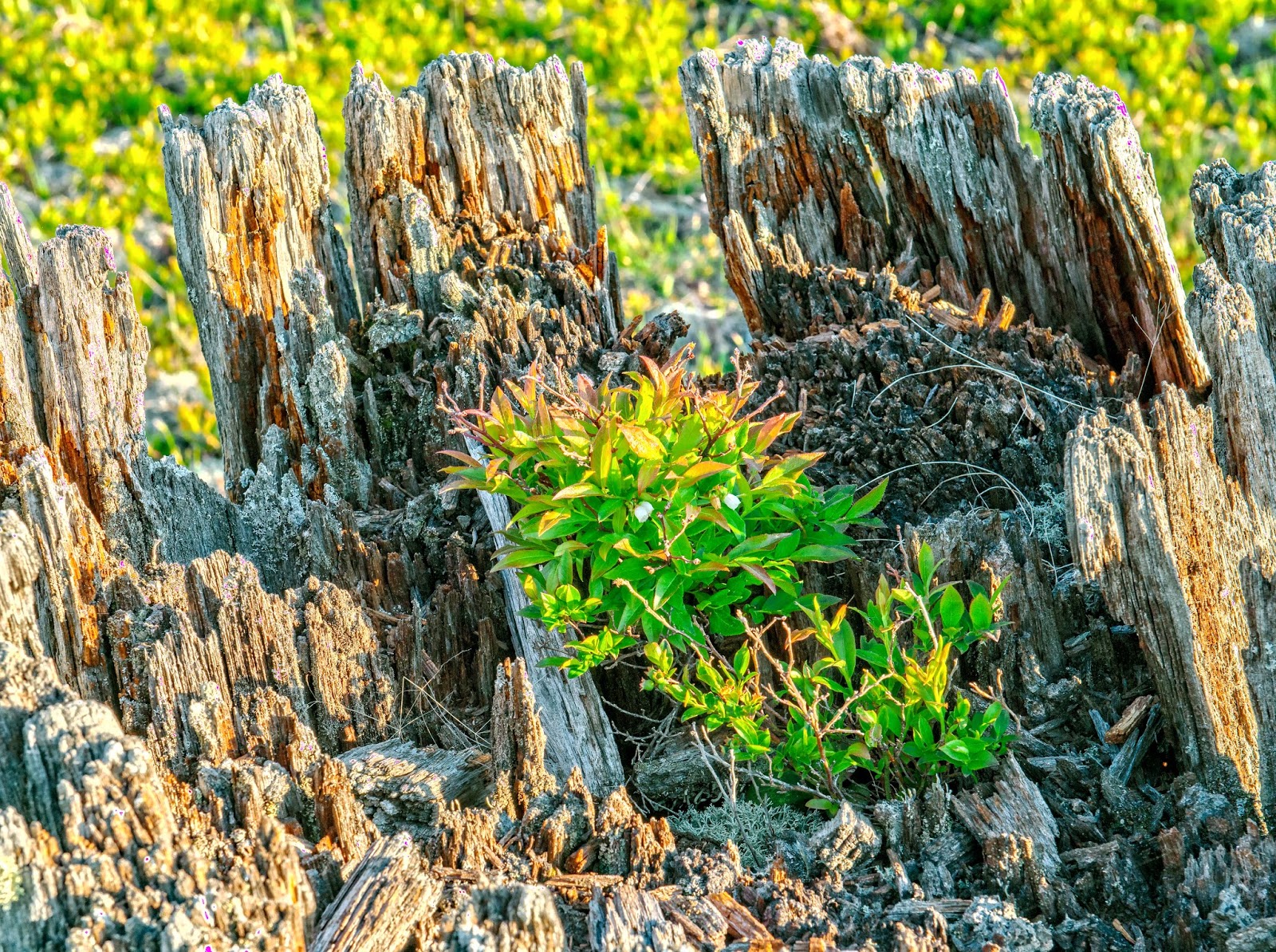
Often, these plains are referred to simply as a stump cemetery. While biologically meaningless, that’s fair enough.


Except, then it’s a graveyard of harvested old growth white pine slowly morphing into a spindly forest of ferns.


I suppose that when you walk this same landscape during the height of summer, grasshoppers rise in waves before you like sand thrown to the wind.

Ultimately, I see the Kingston Plains as a great gaping wound, inexorably healing into something it should never have been.


And would never have become, given a better, saner world. The hand of man came down hard upon this place, but did not kill it.


Could not kill it. No matter our Herculean effort, later compounded by a hundred years of callous indifference, after we believed these plains were well & truly dead.


The late teacher and poet Patrick O’Neill sang, Death is life.

That I know of, there’s no other easily accessible scar ripped by our perennial ambition into the magnificent emerald necklace draped around the great Superior Basin where that fact is laid so plain.


Though it might take another hundred, a thousand, ten thousand years or more, here is proof that life finds a way. Even on blasted ground.

In the end, I suppose that’s what draws me back to the profoundly damaged, maddeningly complex, yet resolutely rich kingdom of the Kingston Plains.

Pay me no mind, I whispered to the wolves.

I'm just passing through.


Friday, April 26, 2019

Grand Marais MI – Harbor of Safe Refuge, Part 2


It's said Grand Marais is the oldest non-Native place name on Lake Superior.  Maybe that's so, but it only figures haggard crews of vaguely white guys muscling wave battered canoes across open seas had occasion to call it other things, prior.

Some variation on safe refuge, I'd think. Thank god appended, depending.

In French, Grand Marais means great marsh. Since it's historically been a harbor not a marsh, some folk think the name got mistranslated from maré, or pond. No one knows for sure.

The town’s story is in many ways typical to white settlement along the Superior Basin, though exacerbated by isolation even in a region noted for it. Below, at the very end of the faraway point you can just make out the light standard detailed at the top of this page.


That ever-shifting mountain of sand hems the place in from the west. And what you don't know about the big water beyond won't hurt you unless you're on it, in which case it could kill you. This stretch of Superior nurses a wicked mean hunger for boats of all sizes.


Indians lived in and around these parts maybe ten thousand years. Then suddenly (as such things go), mostly they didn't. Despite the all-seeing eye of the ether, what natives called the spot before any white man ever thought of it remains unknown to me.

The first European on record visited in 1658. He seemed to like the place. Voyageurs came and went. In time, a trading post was built and a nascent village gathered around that. Commercial fishing commenced during the 1860's.

In the 1870's the lumbermen arrived. Soon, those were as locusts.

Civilization brought the requisite railway, saloons, a hospital, banks and a livery. Even a cigar factory, speaking to terminal isolation. Population peaked at over 2,000 souls. Grand Marais thrived until the first decade of the 20th century.

The lumber played out. Millworks closed. The locusts moved on.


Cook Curtis & Miller Sawmill machinery building


The train stopped running in 1910. Afterwards, you could either catch a packet freighter running this way then that along the lake or the stage from also isolated Seney, where at least they still had a train. To that point, the town shares much the same narrative as Fayette and Nahma to the south.

Except Lake Superior isn't Lake Michigan, so Grand Marais didn't suffer their fate. Commercial fishing helped sustain the place until after the first lamprey arrived in Superior courtesy of the Welland Canal, no later than 1938.

Then like the Indians, the pine and the train after that, soon the lake trout too were mostly gone.


For enterprise, what remained of the little boom & bust settlement turned primarily to tourism. That's about where we came in.

*

When Heather and I first visited Grand Marais, Jim Harrison might be found holding court at the Dunes Saloon, now called the Lake Superior Brewing Company. Harrison's camp was out near the Blind Sucker River.

One of the all-time great river names, that used to be the more prosaic 'Sucker River' lumbermen floated logs down. Later it was converted to a spring fed swamp and rechristened the 'Dead Sucker River'. Today, the Sucker runs officially Blind into the big lake.

By any name, from there Grand Marais is pretty well locked in by wilderness and wild water all the way east to Whitefish Point. That's a long way.


Jim Harrison's gone. Bertha Chilson's Cozy Corner Café now houses the Grand Marais Outfitters. On the town’s register of historic buildings, the retrofit is said to have made the first ‘green’ building in Alger County.


Even with that, Grand Marais still hosts a classic American diner. This one salvaged and relocated more than once, now restored to gleaming glory just down the curling harbor walk from Bertha’s old joint.


Ellen Airgood went to Grand Marais on a camping trip and fell in love.
Together with her husband Rick, they rescued a dilapidated diner of Pennsylvanian origin from a field in Illinois. Hauled that sucker up over the Mackinaw Bridge, which must’ve been quite the sight. Then with much love and hard work, at the edge of the wilderness they gave it new life as the West Bay Diner & Delicatessen.

Like Bertha Chilson before them, Ellen and Rick offer fine fare served with generosity of spirit from a smallish space in the most splendid of settings.


As if that's not enough, Ellen also made herself an Upper Peninsula author of note. Like Jim Harrison before her, she’s inspired by Grand Marais’ rich sense of history and place. From an interview with National Public Radio about her novel South of Superior:

“I really wanted to write about the north… I think it’s full of characters that I’m not sure they make people like this anymore – very independent, self-reliant, full of capability… You might almost be in another time, only you’re not. It’s a little bit magical.

To me the lake is a character. It shapes the community. It shapes the people. It shapes the personalities, the attitude towards life.”


*


After the Odyssey ended, the Kingston Plains was the site I most needed to work more. The place nags me. I positively pine for it.


Happily, the Plains is near storied Grand Marais. Still a harbor of safe refuge, as the voracious appetite of windblown sand, wild water and complex history combined somehow haven’t yet managed to eat it.


So should you one day make it off the road, out of the woods or in from Superior exhausted and hungry, haven waits at the great marsh (or pond). As it has for centuries.

And thank god for that, since all manner of safe refuge is necessary when trying to take full account of a wilderness called the Kingston Plains.

From the safety of Grand Marais, we'll head there next...