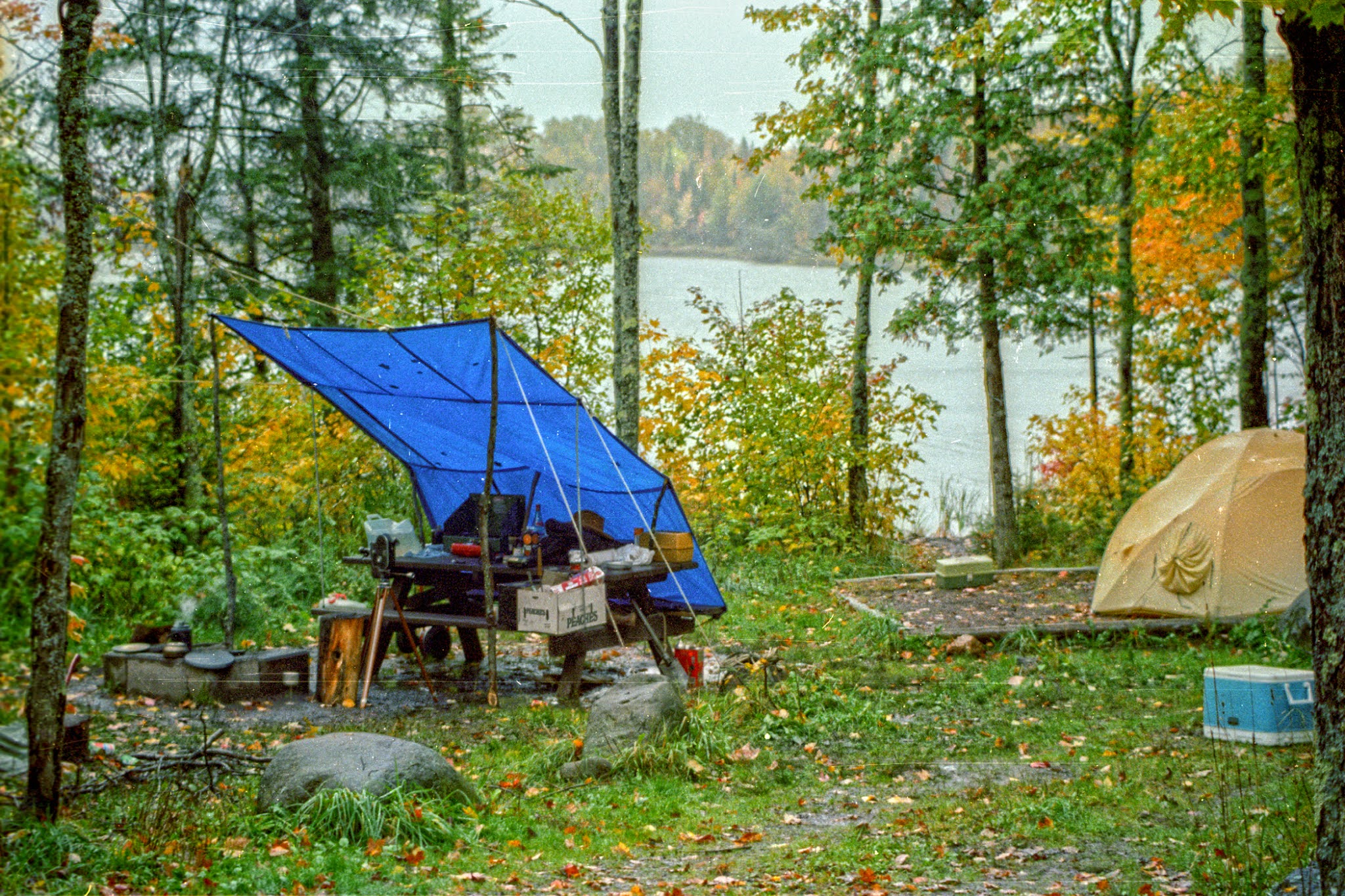
Thirty-eight years ago tomorrow morning, Heather took my
hand in marriage. Didn't fully understand why she'd do that then, it's still
something of a mystery to me today.
S'okay. Mystery is the stuff of life.
By this time the day after, we'd set up camp in the
Porcupine Mountains Wilderness for the first week of our honeymoon on the shore
of Lake Superior.
The second week we spent at Bobcat Lake, in the Ottawa
National Forest.
We'd been going to the U.P. together for some years
beforehand and I don't recall there being any real question but that we'd
honeymoon there.
When younger, autumn was our preferred time in the
northwoods. Tent camping during late September in the wilderness was frequently
hard. It tested us and mostly, we passed.
Over time, August became our preferred month because that
far north it offers the best of both worlds. Many days are still warm enough to
enjoy quality time at the beach…
…while others offer glimpses of autumn's cherished mystery.
By late August, summer's harsh light is softened.
Though the living forest remains lush and green.
Save for 'round the edges, where September can be seen.
In my heart of hearts, I still love northwoods autumn best. Except we've been tested, have prospered for the experience and over the many years since, haven't
forgotten.
So the reasonably long days of late summer that come
mostly filled with warmth and easy living make by far the stronger case.
Besides, autumn's coming right down the pike. Nothing will
stop it and winter's close behind.
I've wanted for years to get a great picture of a praying
mantis. All its other peculiarities aside, the thing about a mantis is that it
looks you right in the eye and no bones about it.
The gaze of other insects is often
opaque. Not so, the mantis. It sees you.
On a humid summer evening with a squall line bearing down
and knowing we'd soon have to duck inside, I finally got my chance. This young one appeared
as if from nowhere.
I raced inside, grabbed the Nikon and happily, didn't blow
it…
It's been an up and down year on our prairie garden. A chill
spring led to prolonged drought, followed by violent storms, then persistent
heat, high humidity and periodically, more fierce storms.
Though I'd my doubts throughout June and most of July, by
August the resilience of prairie life won out.
Now with every passing day, the light softens and recedes.
With that, the food supply is steadily constricted. It's getting crowded out there.
While there's still some pollen left on the Echinacea…
…that's increasingly the province of birds, whose sloppy
eating habits spread the seed that'll inevitably turn into next spring's bounty.
It's been a fine year for monarchs. At any given time I can
stand out in the yard and as many as five of them flit around me in the breeze.
They jealously guard the butterfly bushes, which will provide for
latecomer's the last food available after autumn's first frost.
My friends the Great Black Wasps returned, made babies and
then taught their kids where the good stuff is. Each day, those buster the Greek Oregano
from first light to last.
This year featured fewer Skippers than I'm accustomed to, but
there were some.
Everyone works harder now, for less.
With evening, cicadas sing in raucous chorus.
Afterwards, the nightshift takes over and critters I'll likely never see pronounce their existence just the same.
Every living thing on the prairie knows
exactly what time it is. And that time is getting late.
Maybe this year will be when we find a monarch
caterpillar on our milkweed. After all, that's why we grow it. As is,
these hardy little buggers prevail.
In any event, we'll always have the mantis. We didn't, until
one dropped by before the storm and said Here's
looking at you, kid.
At this point, I'm just happy I was here to see it. And am utterly
convinced the mantis saw me, for sure.
Again this year, my dear friend Phil helps us celebrate Lake Superior Day. I've learned more about the Superior region from Phil than anyone I've ever met, and am pleased to have his contribution.
Images & text by Philip J. Kucera, except as noted...
Drive Wisconsin Highway 13 north. It's seventy miles of wonder
along the state's "North Coast" and was recently designated a National
Scenic Byway for good reason.
Start your journey at the Northern Great Lakes Visitor Center near Ashland, a proper intro to
the history and culture of the entire Lake Superior basin. It's just beyond a
US-2 roundabout guiding you to 13 north.
With twenty-one islands, twelve miles of mainland shoreline, nine historic
lighthouses and sea caves to explore, the Apostle Islands National Lakeshore is the highlight
of the Peninsula. Lakeshore activities are headquartered in Bayfield, population 463.
Inland, this vintage fishing village turned modern tourist town is
surrounded by apple orchards and dotted with berry, while fish tugs and
yachts nose each other lakeside. During early October well over 30,000 people might gather
at the little hillside community to celebrate its annual Apple Fest.
Among America's national parks there's a uniqueness to the
Apostles. Here the goal is
to preserve not only the natural history of the region, but the cultural
history as well. Boats take you on tours of old fishing encampments,
lighthouses, to camp on an island, or for a grand tour through the island
chain.
Even a family picnic…
Elizabeth Abernathy Hull, Public domain, via Wikimedia Commons
On Basswood, visitors can camp overnight, search for the remains of the
McLeod-Brigham homestead (farmed from 1865 to 1923) and explore the rust
and bust of the former Bass Island Brownstone Company quarry - in 1868, the first to open in
the Bayfield region.
Lake Superior Sandstone
During the 1800's, tough Apostle brownstone built untold numbers of architectural
masterpieces both public and private around the Great Lakes.
Many of those still stand proud today.
Back in town it's spring and "Bayfield in Bloom." Nature's
painted leaves are on display in autumn, retired Christmas trees mark an ice
road to Madeline Island come mid winter.
A short ferry ride over shimmering crystalline waters to La Pointe
on Madeline Island, brings
you to where the first fur trade rendezvous' on the big lake took place in the
late 1600s. A state park and two museums, shops and restaurants welcome you.
Consider driving the remaining miles of #13. At Frog Bay on the Red Cliff Reservation, the first tribal national park
in America protects nearly a mile of sandy Lake Superior shoreline amid the
tribal forest.
Image by FJH
Cornucopia is
a horn of plenty from where fish tugs once more search for lake trout,
whitefish and herring on the open lake. Small farms feed the region.
Kayakers cast off to view sea caves. Shops built in old fish
houses display the work of regional artists and crafters.
Six seamen from a crew of
twenty-nine on the ill-fated SS Edmund Fitzgerald called the Bayfield region home.
At Port Wing on the
Flag River, near the northern terminus of Wisconsin Highway 13, a monument
stands in a field of Marram or beach grass,
backed by masses of wild red roses at a lakeshore park. Here a sculpted sailor
peers out over the waters of Superior, on watch day and night.
On Wisconsin's north
coast, it's always about the lake.
Greek oregano bolts in our garden. All manner of
pollen hungry fliers work it under a hot summer sun. Great Black Wasps have yet to return. Just a hint of the much hyped great cicada invasion.
Ants, we've enough of. Most everything else continues apace.
In the world at large, drought busting rains of late June helped
turn early July's prairie robust.
Happily, I made it out and about in time for the season's last
wild roses.
Lots of roses.
I found the prairie made so lush by rain and blazing sun that
it can't be taken at a glance but to freeze it.
And even then...
When I was a kid on the 'empty' lots we called prairie, it was mostly the fauna that
interested me, not the flora. Bugs and a multitude of other unmarked critters
abound in the grass.
I knew those saw me. The plants not so much.
These days, flora breaks at least even.
The prairie is at once sharp-edged and soft.
Elegant.
Riotous.
The prairie overflows with a rich diversity of life. So by any measure that matters, is wonderous.
Whether in the northwoods or on the grasslands, my primary land-looking directive has always been simple.
If open water's suspected back there, try and push through to see it.
The American tradition of town bands goes back to the beginning.
As we grew into a recognizable country, successive waves of
immigrants added their own gifts. When the British fife & drum military tradition
was sufficiently evolved, it became distinctly American.
Every band reflected their own community. There were thousands of them across the country. They were a community pride.
Probably, John Phillip Sousa didn't do much polka. He was a national act. An American act. Likely ignorant of local cultural nuance...
For the longest time, after a day in the woods I'd retire to the now defunct Traveler's Motel (down the hill from what used to be my great Uncle John's farm) for a quiet restful evening spent in a clean, safe place among friendly people.
On certain nights, the breeze carried the defining sound of brass and drums (lots of drums) practicing together on the lawn at the Legion. Sometimes, that drew me back out.
Maybe I'd go over and watch. More often, I hit the Dairy Queen down the block from the Legion, sitting outside eating an ice cream cone, listening to my hometown
band play. In the setting sun, A.D. Johnston H.S. across the street sometimes turns gold.
Born to be chattel, my Grandmother graduated from Johnston with honors. She was salutatorian, Class of 1929. Probably about as high as the bright girl could go, then.
These days, when the stoplight between the high school and the Dairy Queen starts blinking yellow for the night, it's been a good long day.
I finally captured the Goldenaires at the annual town picnic, 2019. Not full strength nor decked out in all their golden glory, but the drumming went on and I was there.
Maybe that plays to the little kid in me, I dunno.
Marty's continued existence helps keep alive the multigenerational narrative that's always made tiny northwoods Bessemer feel most like home to me. Even despite my being big city born & raised. More's the wonder, eh?
Call that genetic pride of place, I guess. Or nostalgia for riches spent before I ever got there to share.
Today, my affection for Bessemer's town band feels like patriotism. Since that's too often an undercut bank failing beside a dangerous river, we must be careful where we step.
The American Promise remains unfulfilled for far too many, way too long. Criminally many, shamefully long. Nobody can truthfully deny it.
Just the same, if I could reasonably spend this 4th of July in Bessemer MI, with the Goldenaires playing their hearts out while bombs burst and rockets red glared, I would. Instead, I'll be content knowing it's mostly all still there.
Mostly. That's just the way of things. Has been, forever.
So happy 244th birthday, United States of America. Best get at it. You're not exactly young anymore and there's still much to do.
And here's to Marty's Goldenaires. Long may they play.