Thursday, April 21, 2022

Shining Light on the Prairie – The 1st Butterfly of 2022

And of course, it was a Cabbage White. Typically the first to arrive, most often the last to depart.

Hardy buggers. Foreign invaders too, but that was 150 years or so ago and I wonder how long it takes before an invader becomes a resident. I grew up with these. They were never not here.

I wonder too what the little fellow eats. It's been a cold, dreary spring. That's made my treasured Lupine happy, but those're a ways away yet. Only Bluebells and Daffodils are in residence. Not much food there.

The pioneer butterfly this morning was a fleeting glimpse in a warming sun and my having seen it was entirely enough for today.


August, 2018


Wednesday, April 13, 2022

Zion - Ten Years After, Part 3


High Desert, Endless War


Time came to leave Zion, Heather and I chose not to go out the same way we came in. There lay the graveyard of Grafton, both literal and figurative.

Been there, done that.


Even if we hadn't, taming the American West is foundational national myth  celebrated in story, song and (especially) movies, even before the culturally formative 'Golden Age of Television' came awash in "adult westerns."

That story is in our bones. By now, it's in everybody's bones.


So on our way out of Zion we chose the back door, traveling up and over the towering canyon all the way to high desert, specifically in search of a far older story than the one peddled so avidly to crowds of tourists below.


No one knows how many people lived in what's now the United States prior to it's appropriation by mostly white people. Seems likely some millions of just plain folk making their way, much as they had for millennia by then.


What's reasonably true is by 1890, the robust and diverse population that had evolved and by & large thrived here for untold thousands of years was cut down to about 250,000 native souls. The official census tells us so.


The causes of this horrific decline were myriad. White folk brought a variety of foreign diseases with them and people not accustomed to living with those died in droves. No vaccines or mask mandates in those days, alas.

Of course, diminishing/diminished resources are commonplace to the story of Western Civilization. We levied what was newly 'ours' with a vengeance and from that the land of the free carved a new cultural empire that supplanted the old.


Mesabi Range, MN

But the concerted, century's long genocide waged by mostly white folk against an entire people they'd later see fit to romanticize as nobly savage, that was Modern Civilization's long game showing its cruel hand.


Thankfully, we didn't completely succeed in cancelling the older culture.


That doesn't mean some folk aren't still trying.

Agawa Rock is among my favorites sites on the Superior Basin. When I learned there was rock art @Zion, I put that on the list. Considering it's Zion freakin' National Park, it figured to be easy.


In the end it was, but only because a fellow traveler pointed us the exact way. There's no parking lot to speak of, just a wide spot on the shoulder of the road. The trail's not marked. That and general ignorance is maintained for the site's protection.


Though Zion was to us an utterly alien landscape, as in the Superior wilderness, we were never alone.


A short walk in and we found the greater perspective on human history that we'd sought. A story so enduring that when considering mythic cultural status, it puts both colonialist claptrap and two-gun slingin' cowboys to shame by its continued existence.


Yes, to 21st Century eyes the story carved in stone by our continental predecessors can sometimes be obscure. I mean…


Early American peoples weren't homogenous. They didn't always 'get along.' They were just folk, after all. And despite the perhaps unprecedented natural wealth of their continent, it's then and now a hard land to thrive on.

Sustainable success is a mean taskmaster.

At Zion, I was struck by similarities between these petroglyphs and the pictographs at Agawa. Admittedly, the ungulates are different. Then there's that canoe. Don't see many of those on sand.

Just the same...


Reconsidering Zion reminded me yet again of how naturally rich and diverse this great land was/is.

Also that Western Civilization was constructed not of whole cloth but on an accumulation of those cultures that preceded it, and we collectively depend on that perennial nourishment still.


Traditionally, failing cultures tighten their grasp on history's narrative. It's a fool's errand. Story doesn't go anywhere.


Ontonagon County, MI

Except that's why today there's no trail marker to the deeper human history of Zion, from before anyone thought to call it that.

Somehow, an age old narrative predating the most recent by a considerable wide margin manages to offend and/or frighten some people to no end.

Must be powerful stuff, right?


On a national upswing, the populist impulse to cancel history is simple arrogance. Cultural dominance on such a massive scale as ours breeds presumed ownership right in. I'm quite sure if there is a god, it believes in its prerogatives.

Maybe even takes those for granted.


On the nationalist downslide, consider the collective obligation to name that same arrogant impulse for the raw, grasping fear that it plainly is.

An enemy, of anything resembling liberty.


Houghton County, MI


There's only one earthly story and we're all in it together. Then, now, whenever. Ungulates included.

And that transparent fact makes some clowns just want to watch the circus burn.

Not even counting the daily news, having once discovered the truth painted on a ruined sacred stone, I must take it as given.


Houghton County, MI


Thursday, March 31, 2022

Zion – Ten Years After, Part 2


Grafton

Shifting sands, foundered fortunes.


Follow the Virgin River a few miles out of Zion's canyon and you'll come to the ghost town of Grafton, current population 0.

Far as I can tell.

Grafton didn't used to be where you'll find it today. The Great Flood of 1862 washed away the original and when the river finally receded, Grafton got relocated to what was hoped would be a better spot along the Virgin River.

It wasn't, much.


Eager for a cash crop, the settlers planted cotton but not enough food. After surviving their critical mistake, keeping irrigation channels clear of sand was a regular, backbreaking chore. The Virgin giveth, then giveth some more.

During the "Indian troubles" of 1866 – 1868, white settlers in the region went for strength in numbers and the residents of Grafton relocated to other nearby towns. After the Troubles, some of them returned.

Apparently, the last resident of Graton left in 1945 and now it's part of Zion National Park.


I've got multiples the image below, captured at different sites from Tennessee to Kentucky, through Wisconsin and all over the wilds of Superior. It's a commonplace at such sites.

So I found Grafton a bit of a bore, because I didn't travel all that way just to spend time on easy stuff like I'd already seen dozens of time before:


Robert M. Berry, his brother Joseph and Robert's young wife M. Isabelle Hales were "killed by Indians" on April 2nd, 1866.


The Internet tells us their deaths didn't happen in Grafton, but there they are in the local graveyard just the same. Surrounded by well maintained wood fencing, out of respect and for "added protection."


Isabelle wasn't quite twenty. Utterly unmolested by all but sun and sand, her stone provides a lasting record that once, she was there.

And despite her briefly anonymous life, is still treated with respect even today.


Preserved cultural artifacts such as Grafton often encourage tourists to confuse culture for history. Tourists buy into that at their own peril, as the confusion gives birth to foundational narrative.

Then they take cherished myth into the voting booth with them and imperil us all.


Travelers, they dig deeper.

Every chance they get, wherever they are…


Thursday, March 24, 2022

Zion - Ten Years After

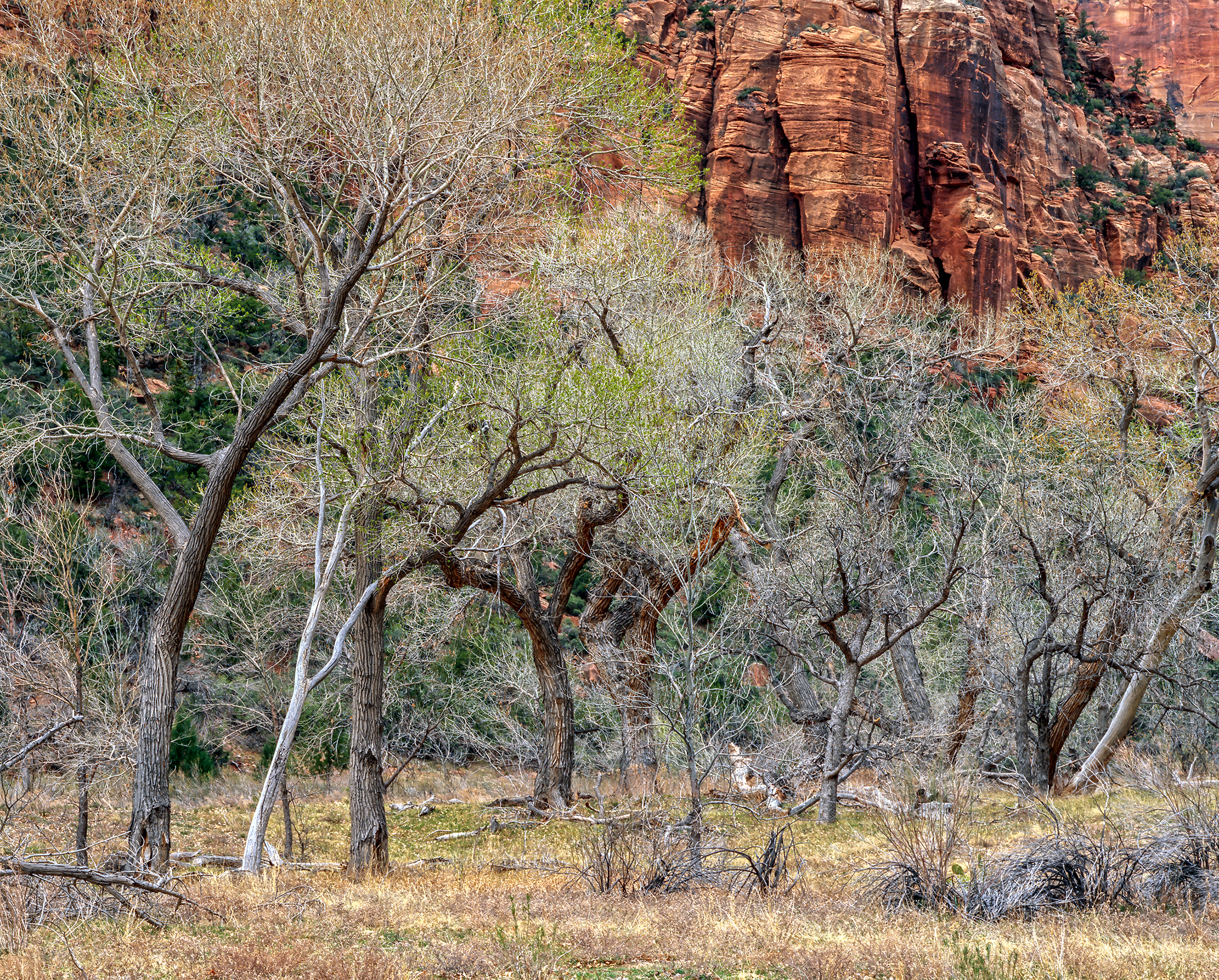
The Canyon


Ten years ago this week, a convention in Utah sidetracked my Odyssey around Superior, which by then was a regular workflow routine. Squeezing opportunity from necessity, Heather and I built in a few days pleasure before business ever began.


I left the Linhof and my irreplaceable stack of 4x5 film at home. Utah was 'off topic,' after all. But I went to the great western wilderness well armed with the Mamiya and plenty of transparency film.


And of course, the unassuming if nonetheless revolutionary toy Canon. I pointed that at all the wonders I'd not dare waste precious film on.


If not at least fabled Olympus beyond that, then what?

At one point a fellow traveler told me I shot film like my "hair was on fire." I barely slept, it's true.


Somewhere I read that white folk who early on entered this canyon fell to their knees and wept at the sight.


I don't care if that's true. It should be, considering the likely beliefs they carted in with them to the place, which early on they called 'Zion.'

In 1919, Pres. William Howard Taft federally protected the area and named it Mukuntuweap in honor the Paiute people who used to live there but mostly didn't, anymore. The name was thought to mean 'straight canyon', but that's not necessarily so.


In 1919 and afraid the name was scaring the white folk away, the assistant director of the newly formed National Park Service took it upon himself to rename the place 'Zion', with the actual director was suffering from depression and otherwise unavailable to do the job.

A year later Monument was changed to National Park and Zion it's been ever since. The rest, as they say, is history.


What's true is that at Zion, even stone weeps.


I can attest to that, I've seen it.


Late one night in particular, the solid dark walls of the place and the sound of a barely seen Virgin River running through it damned near enveloped me. Names didn't matter.


At the canyon's base, there's enough water to get by on. Early white settlers farmed there and maybe an Indian they dubbed Muggins, too.

No trace of any of them remains, except in story.


Sunday, March 20, 2022

1st of Spring, 2022


By overwhelming consensus, spring has arrived.


On or about the exact vernal equinox, I went out to see for myself.


On the ground in real time, the truth proved complex.


Even weirdly unsettled.


Land looking for life turned to light looking pretty quick.


Signs of renewed life weren't abundant.


But they were there if you looked hard enough…


…and for the right thing.